The third core course, Organizational Design, prompted a forum discussion with my classmates around the McKinsey article "It's time for leaders to get real about hybrid" and why hybrid work is here to stay.
Companies that fail to adjust to market requirements — whether driven by clients or the workforce — will slowly die. Resources aren't clients, but they're the key to creating our products, and we need to retain the best of them by putting them in the right environment to perform at their best. Embracing hybrid work has become a crucial factor in attracting high performers and maintaining a competitive position.
High vs. low performers in hybrid work
Hybrid work has emerged as a necessity, but it has introduced real challenges: diminished team cohesion, fewer opportunities for spontaneous collaboration, and the risk of feeling disconnected from organisational culture. High performers and low performers experience this very differently — low performers often need more support and structure, while top performers are independent, goal-oriented, and thrive the more comfortable they feel in their environment.
The impact of hierarchical organisational design
Organisational design plays a crucial role in fostering belonging, safety, and trust — the foundation of a successful hybrid environment. My EMBA cohort agreed that the core problem sits in the high hierarchical structure of most large companies.
Building engagement and belonging
A recurring theme in our discussion was the difficulty of fostering belonging in a hybrid environment, where people can feel disconnected when remote and team-building opportunities are limited.
The role of psychological safety
The stressors of hybrid work go beyond logistics — isolation and blurred boundaries between work and home affect mental health directly, and well-being cannot exist without a psychologically safe environment. Amy Edmondson's book The Fearless Organization frames this well: hybrid work with high performance cannot exist without safety.
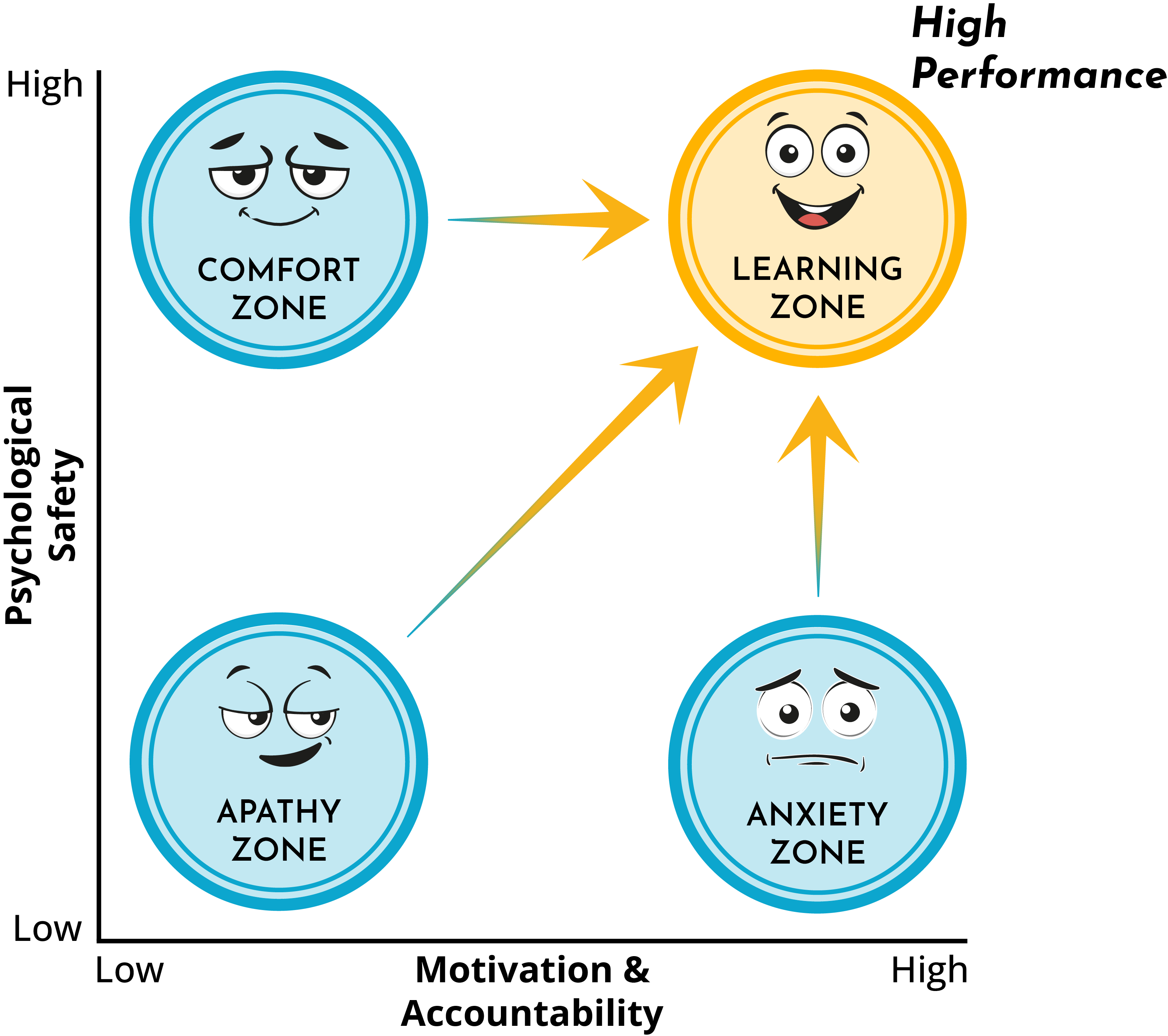
High pressure with low safety produces anxiety, fear and burnout. Low pressure with low safety produces apathy and stagnation. Low pressure with high safety keeps people comfortable but stalls innovation. Only high pressure combined with high safety creates the conditions for learning and innovation to thrive. Psychological safety enables people to:
- Take risks without fear of retaliation
- Learn from failure constructively
- Collaborate effectively to achieve shared goals
What can leaders do? Be present. Prioritise your team's well-being over the product you're creating — if the team is aligned and supported, the product follows. Once trust is established, step back and let the team work.
- Be a role model — show vulnerability, openness and humility
- Encourage risk-taking — reassure people that failure is part of learning
- Maintain accountability — set high expectations while providing support
Satya Nadella's leadership at Microsoft exemplifies all three: openly acknowledging past mistakes, shifting from a 'know-it-all' to a 'learn-it-all' culture, encouraging risk-taking that fuelled Azure's rapid growth, and maintaining accountability by aligning individual and team goals with the company's vision.
Conclusion
I've made these approaches my bible for leadership, and whenever I've applied them, the results — from clients and colleagues alike — have been exceptional, because we are human beings who thrive when we're in the best condition to express ourselves. Some managers argue this only works at companies with margins high enough to cover inefficiencies, missing the inefficiencies — wasted hours, low productivity, people simply waiting for payday — already present in their own organisations.
Start applying these approaches. Start thinking differently. You'll see your margins increasing, your capacity for innovation growing, and your team's motivation skyrocketing. The future of work is hybrid, and the future of leadership is human.